
The India Story: A Market of Unique Challenges & Opportunities
India is not just adopting global trends; it is shaping its own solar revolution. The country's ambitious targets, unique geographical constraints, and strong policy support make it one of the most exciting solar markets globally.
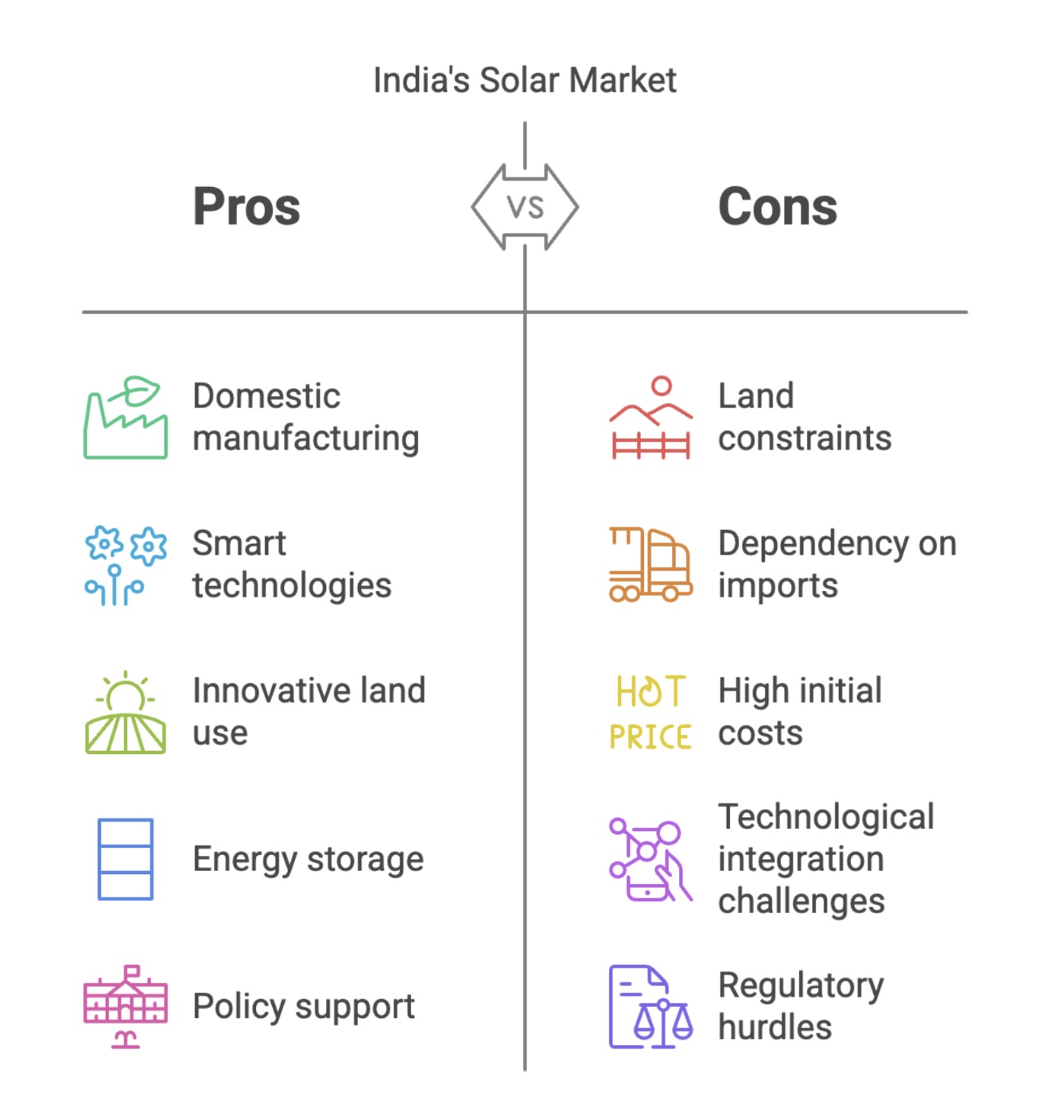
Pros and cons of India's solar market landscape
1. Strong Push for Domestic Manufacturing
India's focus on self-reliance is evident through:
- Production Linked Incentive (PLI) Scheme to boost solar manufacturing.
- Domestic Content Requirement (DCR) policies to reduce dependency on imports (particularly from China).
- Companies like Tata Solar expanding integrated cell and module plants to strengthen India's supply chain.
2. Smart Solar Technologies: AI, IoT & Blockchain Adoption
India is investing in digital transformation, integrating:
- AI-powered predictive maintenance to optimize solar asset performance.
- Blockchain-based energy trading for transparent and decentralized solar transactions.
3. Overcoming Land Constraints with Innovative Deployment
Land availability is a key challenge in India, but innovative solutions are emerging:
- Agrivoltaics: Combining solar farms with agriculture, allowing farmers to generate power without sacrificing crop yield.
- Floating solar projects on reservoirs and dams, optimizing underutilized water surfaces for energy production.
4. Energy Storage as a Critical Enabler
India recognizes that without reliable storage, solar's potential remains limited. Efforts are being made to:
- Scale up lithium-ion and solid-state battery production for grid stability.
- Integrate solar with storage solutions to ensure uninterrupted power supply.
5. Policy & Regulatory Support Driving Growth
The Indian government is backing solar adoption with:
- Enhanced net metering policies to encourage rooftop solar.
- Streamlined approvals and financial incentives for large-scale projects.
- ALMM (Approved List of Models & Manufacturers) Order to ensure quality control in domestic solar production.
6. India's Renewable Energy Goals: Solar at the Forefront
India aims to install 500 GW of renewable capacity by 2030, with solar playing a dominant role. Large-scale solar farms in Rajasthan, Gujarat, and Maharashtra are key to achieving this vision.
Conclusion: A Converging Yet Unique Trajectory
India's solar energy trajectory aligns with global trends in many ways—advancements in photovoltaics, smart grid integration, and energy storage are common themes. However, India also presents a unique narrative:
- Unlike many Western nations, India's strong push for domestic solar manufacturing is a geopolitical and economic necessity.
- Land constraints have made floating solar and agrivoltaics more critical in India than in most other regions.
- While AI and IoT-driven smart solar solutions are growing globally, in India, they are also essential for managing distributed generation in a rapidly growing yet intermittently strained power grid.
The bottom line? India is not just following the global solar revolution—it is pioneering a uniquely tailored approach that blends technological adoption with local challenges and policy-driven innovation. With the world's fastest-growing energy demand, India's innovations and policies will shape the future of solar not just within its borders, but globally as well.
Related Articles
Key Global Innovation Trends in Solar Energy for 2025
From AI-powered solar grids to perovskite breakthroughs and nighttime solar research...
The Future of Wind Energy: Technology, Policy, and Market Growth in 2025
From AI-powered turbines and digital twins to floating offshore farms and India's booming installations...
References
An Off-Grid Life. (2025). Solar power innovations. Retrieved from https://www.anoffgridlife.com/solar-power-innovations/
Energy Digital. (2025). Top 10 solar energy innovations. Retrieved from https://energydigital.com/top10/top-10-solar-energy-innovations
Global Society Earth. (2025). India's solar energy revolution: Innovations, challenges, and global impact. Retrieved from https://www.globalsociety.earth/post/india-s-solar-energy-revolution-innovations-challenges-and-global-impact
GreenLancer. (2025). Solar panel technology trends. Retrieved from https://www.greenlancer.com/post/solar-panel-technology-trends
Harvard Business School. (2025). IFC India 2025: Tata solar. Retrieved from https://www.hbs.edu/environment/blog/post/IFC-India-2025-Tata-solar
Manufacturing Today India. (2025). Powering India's solar revolution: Trends, challenges, and the roadmap to 2025. Retrieved from https://www.manufacturingtodayindia.com/powering-indias-solar-revolution-trends-challenges-and-the-roadmap-to-2025
New Day Solar. (2025). Innovative solar energy trends for 2025 and beyond: The future of solar technology. Retrieved from https://www.newdaysolar.com/innovative-solar-energy-trends-for-2025-and-beyond-the-future-of-solar-technology/
PV Magazine. (2025, March 21). Solar to take lead as India targets 500 GW of renewables by 2030. Retrieved from https://www.pv-magazine.com/2025/03/21/solar-to-take-lead-as-india-targets-500-gw-of-renewables-by-2030/
StartUs Insights. (2025). Solar energy trends. Retrieved from https://www.startus-insights.com/innovators-guide/solar-energy-trends/
TimesTech. (2025). Innovations driving India's solar energy revolution by 2025. Retrieved from https://timestech.in/innovations-driving-indias-solar-energy-revolution-by-2025/